
Anthem to my hometown.
A pair of herring gulls wait in line outside the butcher’s shop. But the shutters are down, the green striped canopy tucked neatly away. Oily pigeons peck away at slabs of yellow limestone. One has rotted toes. A match for the man that limps by, sockless, in slapping shoes. Buttery curls slip from his hood, and there’s a hack of a cough. No hanging baskets this year, no false pink trails of fuchsia and bright petunias, no drip of water making pools to dodge in summer sandals.
The quiet unsettles, like a class of children hushed by fear.
The fade of Barrow-in-Furness, its slide from high history to low money, isn’t something new; it can’t be blamed on a quirk of nature that happened half a world away. Splatters of guano, and the banana-split twine of vetch and dandelion sneaking between paving stones, it all adds up to a hardship index that’s second to none. And so, the townsfolk bow their heads at the icy rush of air from the near-and-so-far Lakes, and they say next to nothing. But they know.
They know, as I do, that life in a place like this can be harsh. But the buzz of community has been a drug; one that blurs the jagged-ragged edges of people and their never-ending mistakes.
Mistakes. I include my own in this. When I give voice to it now, there are only words without heart. After all, my mistake was to never say no. Where’s the need to call that a mistake?
But there’s every need, as it turns out. And so I walk. Walk and talk and look. I breathe it in, this washed-out townscape, and hope it will save me.
The Secrets: Part 1.
Imagine if your place, your town, your home was attached to an island. Or the island was attached to it. Either way, you would want to visit that place, that mile-wide pile of glacial till, with tips of white sand and softly rolling dunes. And you can, because there is a bridge. In a straddle of tidal mud-flats, it will carry you from the mainland to its heartland. Stop at its mid-point, and there is a dormant volcano to view, a sentinel at the gates of the wide estuary. Black Combe by name, and a thing of decaying ochre beauty through the winter and patchwork greens in summer. It could be thirty miles away, paddling in the Irish Sea coast, or it could be right there, in front of your eyes.
It’s in front of mine, right now. I’ve broken the stay local rule, on this bright morning in March. I’ve had to. While the world rails at glass-screened scientists, I rail at the job which once absorbed me, but has now spat me back into the world, then twisted up its nose at my rank smell. I’d like to think Nature is more loyal than that.
The far side of the bridge leads to a promenade of summer memories. With a bed of mussels and mud. The tide has a turquoise tinge, and a glitter of emerald-green. The flats pop breaths of briny air, and oystercatchers wade with expectation, their expressions fixed in a constant kind of astonishment. The odd redshank too, gangly, a teenager amongst waders. Gulls drift and glide, drift, and glide. This is a place where I’ve walked hand-in-hand, with sun toasted shoulder-tops and the promise of freedom. This is the heart of the island. But its biggest secrets lie seven miles each way from here. Northern tip and southern tip, with stamina needed. In between are the homes that people make. Islanders.
Walneyites.
I go north. Take in North Scale, a Norse settlement, now a village of barns and bungalows, of sea-wood and pastel-blue shingle. Meander through lanes of hawthorn and blackthorn, by pastureland that is bleak and sparse, no matter what time of year. It has only salt wind and sand to feed it. And rain from the Irish Sea.
There are thousands of years in this landscape, and walking allows my personal story to slide into its mix. I can find no mitigation for heel-snapping or back-stabbing, except to throw these things into the jaws of the sea, to watch them dissolve. Only now, when I thought I would revel in my lonely on-foot journeys, I find I’m not alone.
With a padlocked town centre, and an influx of fluorescent warning signs hung in bracelets around playgrounds, the townsfolk are seeking diversion elsewhere. And they have sniffed out the sea.
Midpoint on the island is Earnse, a wide expanse of gritty orange sand and granite pebbles. The rockpools of childhood are patrolled by common sea crabs and translucent sand-shrimps, and the occasional salutations of the razor clam. In summer, families huddle behind bright canvas, while the ever-present sea-wind tinges them with pink. This is a place of seaside gathering that has escaped. Not an arcade, not a merry-go-round, not a pier to be found. Only the miles of northern-blue water and sky.
The brave will ditch their Tupperware sandwiches and thermos flasks and walk further. Towards the dunes. Cold, wet sand replaced by a creamy powder, piled in cathedral fashion, and threaded with marram. This, on the doorstep of rules to separate the living from overcrowding and over-hugging. My heart sings. This is the type of solace we are all seeking; me and my theatrical exit from work-life, them with their need to escape the safety of their walls; we all find beauty. Not the bought-and-paid-for tropical beauty that some crave, nor the polished gold-paved beauty with swept-away litter and power-washed paving. Ours is filled with grit and gorse and icy water.
Nature is reserved, preserved, admired on the cap of this island, its salt marshes un-grazed and thronged with sea-lavender and tiny asters. A bygone era, when gravel was grabbed greedily from the ground means that the scarred land is full of watery ponds. To stand on their soft edges and watch for birds, from home and abroad, is a balm for those of us forced into a stifled corner. A sleeping cormorant, a pair of new-fledged swans, whole families of mallards, these transport the thinking, move it from introspection to expansion. To the memory of summer heat and a warm cotton embrace, or winters spent zooming a Puch Maxi along the open sands. And poaching long-line plaice in milky butter, while their olive-green skins wait, all dotted and tangy, to be thrown in the bin.
And Walney has Natterjacks. With their pustuled beauty and haunting eyes, they have made a home of this place, and to listen for them at dusk, with skylarks singing out their approval, is to know that you are home. Does anything else really matter? Is there another dune heath that has its own geranium? Or bee orchids of the palest lilac, and blood?
Some of my dark clouds lift.
I walk and I wonder:
Is the path we’re on the one we choose, or does it choose us?
Could I have tried harder than I did?
How could a virus bring the world to its knees?
There is a match for this end of the island. South, towards that teardrop of antiquity, of monkish history and Lambert Simnel, with its own king and queen and castle: Piel.
Pass by Biggar, a village from a medieval grange, and flat-walk for miles, with gulps of sharp brine-spray and chilled wind for refreshment, then here you are. On Walney’s tail. Shingle shores, and a view of Morecambe Bay that would never have come from Marine Land and the frontier fair. Where is the need for roller-coaster feel-good, or bucket-and-spade nostalgia, when this gem exists for real therapy? But we keep it to ourselves. Keep private the oyster farm and the cattle fields and the grey seal colony, the dune hellebores, and the yellow horned poppy. In our cagouls and high-ankle boots, we walk our way beyond painful chains, towards a new kind of liberty. And stand, transfixed by the sun’s rays, as they slice through weighted grey cloud, to paint a layer of spine-tingling silver across the surface of the sea. My questions don’t hold weight. These are the moments that transform lives.
The Secrets: Part 2.
Ours is a town where industry and nature rub together the shoulders of their craft. They share a bed and whisper in the dark. Even that bridge has a tale to tell. One where it brought a standstill to the townsfolk, on a stifling summer’s afternoon. No one left the island, and no one came home. Telephone calls were made, and mainlanders made up their spare beds and sofas. To my teen self, this felt like the biggest kind of adventure. I was an Islander, back then. When your neighbourhood school didn’t owe you a place. Mine was three miles away. Marooned on the afternoon of The Bridge, I made camp along with my blonde sister, on a bed-settee in my father’s office.
That five-foot gap, with a rush of tidal water beneath, is still a point of discussion for townsfolk of a certain age. But we survived. That’s what makes us human.
And now, as the choke of heavy industry fades from the belly of the town, nature does what it always does. It pokes through.
Where once the iron and steel industry dominated, and graving docks full of estuarine sludge became monuments to a seafaring past, there now exists a haven. But not only for the intrepid users of hiking boots and sturdy legs. Here, a mile-long stretch of parquet pavement and seaside railings allow an inclusion not seen in other wild places. On one side, the island comes into view again, across a stretch of wide green sea, where sailing craft bob and lapwings dig for estuarine worms.
A sharp wind, full of brine and bladderwrack, is never absent from the place; in winter, it is overlaid with ice, but in summer its sharpness is blunted by the perfumed dogrose which covers the walkway’s eastern flank. Rough grassland hides the town’s new and frothy features, while thistles and dandelions keep a small flock of clown-faced gold finches entertained.
A circular display of sea holly, wind-blown lavender and faded rosemary head up this channel side haven, but its feet are less formal, and not for the faint-hearted.
There was once a childish romanticism attached to the high cliffs here. But they are not cliffs. They are banks of waste from an industrial past, gigantic heaps of stony scrap, left when our precious iron currency was smelted. Gorse lights up the lower slopes, and a crafted pathway allows sublime views across the Duddon estuary and out towards the edge of the world.
My home is not far from these cliffs. The path down is gravelly and steep and thrusts the walker back into brutal reality. For here is the town’s industry, up close and personal. Paper mills and wholesalers, builder’s yards, and prefab units, with low rent and concrete parking. I have a childish memory of this cluttered wasteland: rows of post-war social housing, coloured cladding and corrugated roofs, kids who ate bread-and-sugar for tea and fought over the parts of our snack-apples that we couldn’t quite finish. Oh, how things haven’t changed. But the non-standard houses have gone, so that’s something.
The Secrets: Part 3.
The shutters are down, the concrete crumbling. Grey has become a feeling. And yet, no more than two miles in any direction from this centre of boredom and down-at-the-heel buildings, these secrets lie waiting. There is a third, before the finale. One that allows me to walk with abandon.
Schools come and schools go, as fashion changes. In the old-school system, children were given acres and acres of land on which to play. Childhood games in a sprawl of fresh air were deemed as important as maths and English, but not anymore. Accompanying building sell-offs were parcels of land. And so, How Tun Wood was born, from the brains of local people and the hands of the Woodland Trust. But it required commitment. Twenty-five years later and here we have a place of tranquil beauty, of beech and ash, and hazel coppices, of wild undergrowth and bluebells and of the quintessential English hedgerow.
There is perfection in the random layers of these local hedges, a structure that could only have come from a knowing hand and eye. Those words. Hand and eye. Human constraints used to understand this beauty. This warm scent, of grass and Rosa Canina, elder blossom, and gauzy cow-parsley. This spike of nettles and sweet vulnerability of lady’s smock. This greedy dance of dandelion skirts, and the whole green canvas spotted with buttercups and campions. Flawless mother nature on the edge of a sandstone quarry, whose pit of social housing keeps the blinkered away.
When I walk here, there is less guilt. I am no more than a half-mile from home, with no one to tally whether I am out one time or four. And always, there are others with me, but separate. I long for contact, for talk. We could exchange our stories and file the face away for next time. I can call myself retired, though I hate the word. It tastes like a lie. And they will have dogs or babies, or elderly parents, led by the hand.
Emerging from the woods are a latticework of pathways, well-trodden now and pink with a clag of clay and soil. And here is serendipity. From the tip of the westernmost path, the island comes back into view. Its northern cap of golden dunes and scrubby salt-marsh lie like a page torn from a relief map, surrounded by vast Irish blue, and endless sky. A few moments at the quarry’s edge on a smoky-cold evening, and the watcher can almost believe in the possibility of stepping over, and soaring across the townscape, guided only by a twinkle of lights from below.
The Secrets: Finale.
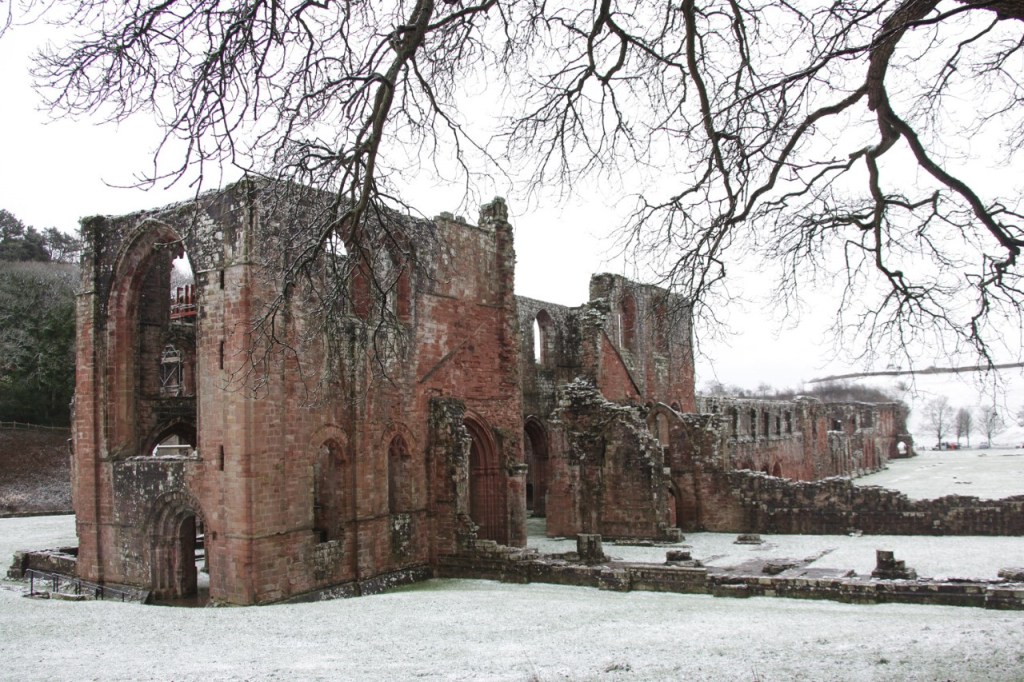
Ours is not a Tudor town. It has no huddle of wattle-and-daub, no thatch, nor hollyhock gardens. But there is a Tudor gem at its heart, a ruin of sandstone in a vale of tears and nightshade.
From a grim height, the A road zooms by, with piled-high trucks of aggregate and human supplies. Who would know that veering East, through a gateway of antiquity, would peel back centuries? Would allow entry to another world, where ancient beech and oak stand as sentinels to light the way, emerald in summer, copper-and-gold at the fade of the year.
To arrive at the gates of this place, The Abbey of Furness, is to follow in the footsteps of the weary and the hungry, the farmers and the clerics, the lost and the found. It is home to none of these, now. Corvids clamber across its highest ledges, safe in the knowledge of their sarcasm, one eye on the soaring buzzards and darting blackbirds that vie for the throne. And what a throne it is. Hand-cut slabs of crumbling pink rock, painted with a mix of mustard lichen and mason’s marks, softened by the years, and hard with the story of a northern winter.
A soft blanket of green provides for visitors, false but necessary and balanced by wild borders of sprightly daffodils and rape and elegant grasses, edged with fresh celandine gold, then early buttercups.
It’s high summer before I dare to venture here again. The guilt heaped on us all by a raft of people we’ll likely never meet, has finally eased. Does guilt ever really ease? Or do you win your internal struggle, simply because you grow stronger?
I have proper boots for Abbey walking. When I pull them out, finally, they are dry and dusty, and one has a sticky web between the eyelets.
Each step I take, downhill into cool green shade, gives a jolt of memory. The last time I walked here, I was a teacher. A leader. A grafter. I was crumbling. Inside. Under the weight of other people’s wants. Now, I’m just a minor criminal, breaking a swathe of rules that are becoming meaningless. The other rebels have got my back.
It is no accident that a beck runs here, hungry, and nibbling at the soft stone. There is glitter at its surface, and silvery moon-eyed fish wend their way, oblivious to the sanctity of the place, the safety, the freedom from plague and pestilence and infinitely small spheres of ribonucleic acid and spikes of protein. Water was the life-blood of this wrecked building, now children use it to float their sycamore-stick rafts, and modern cattle lap on its beaches, while swifts sprint their warnings across the meadow.
A train line slashes through this tranquillity. Of course it does. The valley lies between washed-out northern towns, whose centres were lost a long time ago, but whose people are diamond. To ride these tracks is to taste the giddy freedom of traversing The Kent estuary, to rise with the gentle curlew flock into the mist of early summer, or to feel the welcoming arms of Low Furness at Christmas. So, the railway’s presence is forgiven. And its timeless worker’s cottage, blended with twists of clematis and honeysuckle, juniper and oak, envied.
Now that the summer heat oppresses, I climb the valley side, following paths trodden by monkish feet, for a cool perspective of the scene. The East-to-West of the ruin and the thick, lilac skies before rain, the roll of the fells and the endless woodland, a froth of pink apple blossom in spring, and death-red beech leaves at summer’s end. Who could fail to be moved by this place? What hard heart would rather queue for the television, and its promise of borders open and a summer of travel.
This was always a place of human consolation, of quiet prayer and the handing out of alms. A place that gave more than it grasped. To walk in late spring, through the bridal wildness of garlic and bluebells, is to go home with a full heart.
And if there is, in my mind’s darkest corner, any shred of scepticism, any thought that the human condition can’t be improved with such simplicity, I have only to take the Abbot’s Steps.
A pound of the heart and a sizzle in the thighs leads to the wild wood. A manor house once stood here, in gothic silence, accepted only because of blinkered industrialism. But it had a certain beauty, a sandstone and cool green beauty. Now, its gateways lean, alone and grown over by brambles and starry ground ivy. Here and there, a crumble of stones and moss give rise to thoughts of fairies and trolls. There are none of these, except the fleeting spectre of a young deer and the backstair snapping of windfall twigs.
At the dimming of the year, mellow with smoke-tinged air and pleasing warmth, the confetti of rosebay fluff and shiny conker fruits provide school returners with their nature lessons.
Then, the knife blades of a northern winter will pare this wood down to its bones. Grey-textured tree trunks will wear veinous creepers, while the beech carpets decay to mud. Wild rhododendrons will stay green and glossy and continue their stranglehold despite the local armies of orange clad payback-youths and their misplaced slashing. In winter, it is possible to reimagine what Grahame’s Mole and Rat were running from, and to experience their sense of homecoming. Or Hardy’s ancient pulses froze hard and dry.
Then lovely spring, with hopeful breath, will unfurl the sycamore buds early, and warm the nubs of bluebells. A robin will trot from stem to stump, checking his patch, singing his approval. Birds have secrets. Not for them this nit-picking worry that is frying human awareness. They dart beneath it or soar above it and are glad.
Now though, as summer’s heat becomes the thing longed for then despised, the powerhouse canopies of oak and ash and hazel give cool refuge, while buttercups light the way and apple blossom frills restore the smile. Cracked red earth peeps through where winter treads have worn and mashed, but the margins bulge with dock and nettles, ferns and foxgloves. Those slanting rays are never wasted.
A fishing heron lifts itself as I cut across the meadow. Its wing-drift raises a patch of butterflies, darting their creamy-white bodies in a search for safety. On the path by the beck, I meet a man. His hair and beard are long and woven with grey. He has a setter on a lead. It is craning towards the glint of water.
Good to be out, the man says. Covid police won’t find us here.
He pronounces it cor-vid. That makes me smile.
This is what we have been reduced to. Sneaking around to find our beauty-fix. Like it’s an addiction; like we can’t live without it. Who knew the thing hiding in plain sight would save us?
It is on this walk that I finally discover myself again. There I am. Peeping out from under the crush of other people’s expectation. How does nature do that? How does it clear your eyes? Or touch the soul in you? It’s enough to say that it does. I have simply painted it with words. Those are all I have.


 Paula Hillman, author
Leave a comment