
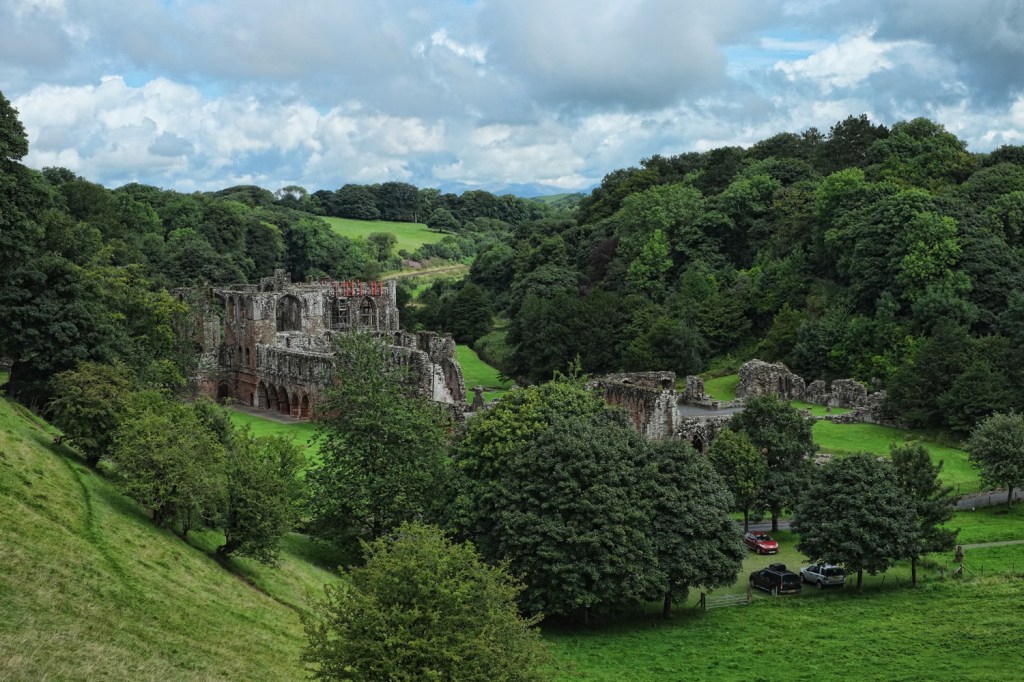
I entered this piece for the 2024 Nature Chronicles Prize. It didn’t get selected, but I quite like the piece. There are some bits from other pieces I have written, and the tone is quite formal, but if you’re a fan of Furness Abbey, you’ll understand the restorative atmosphere of the place! (title stolen from a line in my favourite novel ever!)
On the day I leave my teaching job for good, fireworks split the sky; they aren’t for me. It is a dank and dirty evening, one known locally as bommie night. I chase off the last parent from my classroom, get in my car and drive home. I’m not going back. I have not slept for eight days straight and the disconnect I’m feeling is terrifying. There will be dire consequences if I don’t show up for work tomorrow; devastating consequences if I do. I spend the night on our lounge sofa, sobbing, while my disconcerted husband tries to help. Nothing can be done. My body has been trying to communicate its worried message for some months now. I chose not to listen. It got my attention finally, with this latest bout of anxiety-ridden insomnia. Now, I’m all ears.
A week of hard frosts follow. For many years, I have not been free to walk a November morning, unless it is a weekend. The poignancy of this wintery spell hits me; I am raw, and it is beautiful. I feel disorientated, cut adrift. There is nothing I can do but walk, and I know of a place that might save me.
On the road out of town, hidden by gnarled deciduous woodland, is Furness Abbey. It sits in a valley, named long ago as The Vale of Nightshade: lay-monks had to clear tangles of the deadly plant before building could begin. That was almost nine hundred years ago, and the time-gap resonates. There are beeches, sycamores, ash trees, oaks and shimmering birches; all are tall and concealing, and give a taste of how the land would have looked before clearing. Downhill, the great east window looms up from the trees. It is a place of solace.
The abbey played an important role in the story of England’s religious past, a story that reached far beyond Furness. Its lands were granted by Stephen of Boulogne in 1127, for the foundation of the Abbey of St. Mary. By 1147, the brethren had converted to the Cistercian order. Their ethics were based on land acquisition and hard-farming. Through the next few hundred years, successive abbots upheld this tradition so that at the height of its power, the abbey owned much of Low Furness; too much power and wealth for the Tudor king, Henry Vlll. The story is widely known; Furness Abbey was dissolved. There is a sense of cool serenity in the bones of the place. It renders personal stories insignificant; they hurt less. Nature rules here now. The ruined stone is simply a canvas.
November
Four days after leaving my job, I approach Furness Abbey on foot. There is a car park for those who travel from further afield or do not have the luxury of a day to waste. That used to be my excuse. It is a day of brilliant sunshine without a scrap of warmth. No rays reach the valley this early, and frost covers every surface. Sandstone takes on a grainy quality when damp, and the ruin looks as if it has been painted into the scene by a brush soaked in watery white. There is pink, but a pastel shade, and green too, granular and tipped with crystals of sharp silver: these colours speak to me.
A beck cuts through the valley floor. It borders the ruin then darts past what would once have been the latrines. It has been diverted under the road and out towards a wide meadow. Here, the beck can be crossed by means of a medieval pack-horse bridge. The clay-laden ground is soft underfoot in Cumbrian winters; there can be no walking without high-top boots. A jaunty herd of Friesian bullocks have churned the grass so that it fills with ice-puddles when the temperature drops. They crack underfoot as I walk.
I am still not sleeping. When the autumn term started, with its kicking through early leaf-fall and its Indian summer, something already felt wrong. I could still function, could teach a whole day’s worth of interest and engagement and come back for more, but the heart of it was gone. I made it until half-term. As the day approached for a return to the grinding joy that is November in a school, my ability to sleep disappeared. Looking back, I realise my body was in fight-or-flight mode, and was keeping me from dozing for protection. The physical toll it took, the eye and muscle pain, the sagging face, was indescribable. I did not see a doctor until after the day I walked away. The advice was three-fold: have Zopiclone; give it time; find a therapist. The sleep would come back eventually.
At the far end of the meadow, I stop. From here, it is possible to look up at the scars of this landscape. The drumlins have long been scoured out for their sandstone. Now, they are scattered with gorse and broom, the lower slopes pleasant pastureland. During the abbey’s heyday, agriculture dominated this area. The farming of granges, overseen by live-in lay-brethren, was a speciality of the Cistercians. Those granges have long since been incorporated into Furness, but the names persist: Biggar, North Scale, Roose, Salthouse are a few. The area in which I stand is dominated by Parkhouse Farm, tenanted since the middle-ages. There are Herdwick sheep in the small fields and a handful of Texels on a piece of land near the farmhouse. They look like off-white teddy bears and send thin streams of frosty breath into the morning air.
I track back across the meadow. A path grown over with decaying nettles and brambles leads across the railway line to the bottom of what is known locally as The Amphitheatre. It is a huge patch of grassland, encircled almost completely by steep banking and a wooded sandstone escarpment. Here, the abbey’s fishponds were sited. A criss-cross of ancient paths allow access to the top. These were once sledge-ways. Oxen carted lumps of stone from the quarry here, to the building site in the abbey grounds. I want to climb, but lack of sleep has left me feeling jaded; I decide to try.
The gradient of the slope is 1:1 in places. Sometimes you have to lean forward and use your hands. The view is worth it. A blaze of orange sunlight has broken the valley sides. It catches the highest points of the ruin, turning them from spectral pink to gold. I put my hand against my chest and breathe deeply for a moment. There is a flicker of connection, of emotion, after the numbness of the past few weeks. It fades quickly, but felt real.
Behind me is a tumble of wall that once enclosed the abbey’s private land. It is possible to follow it almost all the way around the precinct. The sandstone is weathered and crumbled and covered in patches of lichen. To lay a hand on it is to travel back to the time when ordinary folk would not be allowed to enter into this sacred and private area. This has an echo of how I feel now. The vicious jaws of the teaching profession have chewed me to a thousand pieces then spat me to the outside. I wonder if those pieces can be reassembled, sewn together in a different configuration ‒ or the one they were originally.
Abbey Mill Café is tucked away at the bottom of the slope. It has tables on an outside patio and a solid fuel stove inside. The beck runs close by. I slither down carefully, taking the final few metres at an impromptu run, and am soon hovering by the café door, reading the specials board, enjoying the smell of mingled coffee and woodsmoke. The building is not eleventh century in origin. A custodian of the abbey and his family lived in the cottage through the Victorian age. There was a water powered corn mill on the site at some point during the monastic era, hence the café’s nod to its heritage. None of this matters. I have loose change in my pocket and want a cup of tea. It is not long before I am sitting on a freshly wiped metal bistro chair, watching a juvenile robin hopping across the grass. I crumble a Biscoff inside its wrapper and scatter the crumbs.
It strikes me for the first time since I began walking here, how strongly nature takes over when humanity decides not to dominate. The Cistercians and their full-on farming shaped this landscape; that is their legacy. But they also left behind a responsiveness: here is tranquillity, destroy it at your peril. The consequence of this is a pocket of unspoilt beauty, of nature gone wild. As I look out from my café table across the frosty morning, my self-absorption slinks away.
Left of the café, cut into a steep wooded bank, is a series of steps. They are crafted from slabs of sandstone, locally quarried. To climb them requires stamina and care. Each tread is narrow, each riser probably twelve inches high. It is not unlike hauling yourself up a ladder, but I do it anyway. This is like Jack’s beanstalk climb, and there is treasure at the top, for here is a stretch of woodland I can only compare to Kenneth Grahame’s Wild Wood. There are hollows of frosted magic, ivy-clad winter trees, gnarled and glittering, and infinite paths that could lead anywhere or nowhere. In an instant, I become Mole on his intrepid journey to find Badger. The scarf, hat and mittens are in place, but I don’t have a soft velour face or a shiny snout. What I do have is a sense that my footsteps across the frozen ruts of mud and beech-leaf mush are layered over so many others.
This Wild Wood has a real name: Abbot’s Wood. Predictable, though not named for the monastic era, but rather for a Victorian manor house built here. It was the home of Sir James Ramsden, leading man in Barrow-in-Furness’ industrial story. The house is long gone. Now, nature pokes through the ruined stone walls and iron gates of the place. Visitors walk their dogs across the old walled gardens, and parties of school children re-imagine Ramsden’s life through photos and teacher expertise.
At the heart of the ruined Victorian garden there was once a concrete bunker. It was to be used in times of nuclear attack, to provide Barrow with a safe place for strategic planning. Children of the late seventies and early eighties, teens looking for somewhere spooky to hang out, would come hand-in-hand with ghostly stories and bottles of cider. I was one of them. Once it was realised no one would survive the kind of atomic attack that the bunker sought to protect from, it was demolished. Tales of the place live on.
The highest ledges of the ruin are home to an array of birds. On other walks, I have seen a pair of peregrines, wood pigeons, a bunch of corvids: rooks, jays, crows and magpies. This morning there are blackbirds, one or two robins and an excess of sparrows and starlings. Nothing can reach them on those ledges. They may become prey; they may not. What strikes me is that the same species will have been here across the years. They survive, they thrive. I doubt they care what their story is. I wonder about mine. For the last few years I have survived as an educator only because of my vast experience. There was no joy to be had. I’ve forgotten what it feels like, anyway. What I have done instead is try and cling to something toxic, rather than face living without it. I’m not the only human to ever have done that. Some inner intelligence has made a decision for me, it has cut me loose to save me. The realisation of this takes my breath away. There is money enough that I can survive; my family are the best I could have created; I am free. The stress-damage will fade, will slide off my shoulders as easily as my teacher persona has done. I find this both exhilarating and chilling. Who am I now?
A steep road leads away from the abbey and back up to civilisation. It is lined with sweeping beech and sycamore trees. The girth of their trunks dates them as ancient: they tower over the road on both sides, and form a ceiling of wintery boughs. No sun has reached here. Patches of ice make the walking dangerous, and I have to switch my tangled thoughts off for a few minutes. I think about some words I read in one of Pierce Brown’s weirdly twenty-first century sci-fi novels: Life is about how we stand before we fall. Not another minute of my life is going to be wasted on things that make me unhappy.
March
It is a day of lively blue skies and sea-wind. I sit on the doorstep and lace my boots. My daughter is accompanying me on a walk to the abbey today. Her camera is slung over her shoulder. She is a person trying to improve her universe. She takes only what she needs; she grows things; she never drives or flies. That she is like this is blamed on me: I called her Rose.
There is something about the light in March: it is razor-edged. The sun sits low but dazzles. I squint at Rose. She tells me to hurry up.
The route we take follows a Victorian lane. Before industrialisation, Furness was an area of farming hamlets connected to each other and to the developing market towns of Dalton and Ulverston by a series of trackways. There is little to recognise from the lane’s Victorian past, but it has an interesting story associated. At its northern end, just before it meets the busy A590, a medieval village once stood. As was common during the monastic era, the village of Sellergarth had sprung up outside the western gate of Furness Abbey. It was an independent settlement: Cistercians did not encourage building near their walls. Sellergarth occupied a site that the notorious abbot, Alexander Banke, wanted to turn into a new deer park. It meant the eviction of 52 tenants and the total destruction of the village. Whilst some of the tenants were rehomed in new holdings at the hamlets of Newbarns and Hawcoat, others were left homeless and landless. Though Abbot Banke was temporarily expelled from his job, his stewardship lasted from 1503 until the early part of 1532. His method of running the abbey has been likened to the management of a property company; exasperating at a time when the whole system of monastic rule was mistrusted. As we pass by the area where Sellergarth is reputed to have stood, Rose and I give a small cheer. In 2014, Story Homes submitted plans to build on the site. They were turned down.
Manor Farm lies adjacent to the Sellergarth area. The farmhouse has the faded gothic style associated with Victorian buildings of this type, and there are lambs in the home field. We peek through a hole in the hawthorn hedge. The scene is practical rather than pastoral. Each lamb has a large red number sprayed on its body; the ewes have matching ones. My daughter gives a gentle message of reassurance to the flock: neither of us will be eating them. I have been a vegetarian for more than forty years, her for twenty. My decision came from a wish to be different, as much as from a worry for animal welfare. In 1981, vegetarianism was for weirdos. I remind Rose of this, and she rolls her eyes because I am repeating a story she has heard many times.
On a grassy bank in front of the ruin, on the other side of the railings, a broad expanse of early daffodils are in full bloom. The contrast between them and the stark winter beauty of a sweeping beech tree is glorious. Within the ruin, the lawns are maintained in an English Heritage style, but the borders have recently been left to grow wild. While this may not be convenient for photographing the place, the tall tangle of thistles and grasses add charm. We stand in front of the railings for a moment longer.
I have been to see a therapist. As I had no intention of taking the sleeping tablets prescribed by a doctor with no empathy, I decided to do the work myself. In my previous life, much of my time had been taken up giving help and advice to parents, and I was happy to be a giver. Being a taker did not sit well. When I told this to the therapist, she tutted. There was no bigger sceptic than me, but she was the expert. She saved me. After four sessions with her, I was back in control.
With a diligence I had not expected, the therapist did a test for depression. The result was negative. She told me I was the world’s biggest control-freak, a people-pleaser and never put myself first; she told me the sleep anxiety was out-of-proportion: she chose not to sleep much herself and hadn’t died; she taught me breathing routines for instant calm, and pointed me towards hypnotherapy. Relaxation and meditation podcasts gave me final freedom from a sleep problem I never thought would end. The woman is a saint.
Rose and I duck off the road and onto a narrow path that follows the precinct wall. It goes upwards steeply and in precarious fashion. Underfoot is claggy red clay, tangled with the bare roots of ancient deciduous woodland. There is little light. A gigantic wall of rough sandstone looms in front of us, a pale pink cliff. Permo-triassic sandstone was laid down 150 million years ago, and forms the bedrock of the Barrow peninsula. It is at near surface level in the abbey area, and has been quarried for centuries to fashion local buildings. The cliff has bedding planes and joints: it’s a geologists dream. Erosion has smoothed its surface and exposed spindly roots from trees at the top. It is a slice through time. More interesting is that a gang of local youths, with no interest in nature or geology, have excavated a pump track here, away from public scrutiny. I have mixed feelings about this. The area is little more than a series of uneven and slippery pathways, hidden from sight. It now has a use. Conversely, the whole thing is a mess. My daughter is angry about it, so we keep moving.
The path opens out at the top of the amphitheatre, on its southern lip. We tramp across dry, winter-blown grass, tracking the wall again until we get a perfect view of the ruin. The cruciform of the church building is visible from here, roofless and pinioned by industrial scaffolding, but still beautiful. The hawthorns and blackthorns on the slope are spikey and bare. The sky is so clear and blue, between scooting clouds we catch a glimpse of the Lakeland fells. A crow takes off from the wall. I watch its swoop and glide while my daughter snaps away, trying to capture everything on her compact Fuji. I want to capture the moment in a different way: it feels so normal. I’m normal. In the last few months before I left teaching, I had convinced myself I was anything but. Stress is a funny thing. The word can be used in such disparaging ways: you must not get stressed; she is suffering from stress; the stress has become overwhelming. We, as humans, have an inbuilt protection system. The biology of it is complex but the activation is simple: one of our senses picks up a shock, and our bodies respond. For fifteen seconds. That is when we decide what to do, and act. Anything after that is fed by our brains. If we are suffering from stress, it’s because we are overthinking those initial shocks. My overthinking took the form of not being good enough; younger people snapping at the edges of my role; the boredom of another ten years doing the same thing, living in the same way. Now, I’m as free as the soaring crow.
We walk on.
A tarmac path has been laid from Abbey Mill Café to an area of the town known as Roose. The path runs parallel to the beck, and was once part of a pack horse route. The Barrow to Lancaster railway passes here. I am aware of William Wordsworth’s sonnets to Furness Abbey, his subtle lament of the railway as annihilator of the peace. Almost two centuries after the Romantic poets thought their world might be destroyed by the fade of yeomen farmers and the rise of industrialisation, we see something different. Change is of its era; in another, it is simply the status quo.
We drop down from the top of the amphitheatre and join this path, opening the gate for a jogger. He is wearing earbuds but nods a thank you. The path can be overgrown with hogweed, brambles and bracken in high summer. On this freezing winter’s day, it is possible to peer through the mesh of hawthorn and blackthorn, across the railway line, to Tunnel Cottage.
The place holds a fascination for many townsfolk. It sits at the mouth of the railway tunnel, and its front gate opens onto a short path edged with wild garlic and nettles. When we walk here today, snowdrops are peeking between the fresh greens of early spring. Impossibly, two Herdwicks are standing on the front doorstep. One has a thick brown coat; a youngster, I think. The other is tatty and grey, with the Herdy sweet face. Both peer at us from across the cottage garden. There is a kissing gate at the end of the path. It is supposed to keep sheep from wandering out of the meadow. Though the cottage has an air of abandonment, with its snarled-up hedges and grimy windows, I have sometimes passed carers on the path. As my daughter points out, these sheep are not getting back to their proper place without help. We push the garden gate wider and step towards them. Once, when walking in the Lake District, we came across a Herdwick caught in brambles. It was tugging and hefting and in a blind panic. My husband approached, thinking he could free it, or at least help it to free itself. There was a strength to the creature we had not expected, and its fear as we approached must have given a final shot of adrenaline so that it tore itself free and fled. When I warn Rose not to underestimate the brute force of a cornered sheep, she rolls her eyes again.
We somehow get the Herdies out of the garden and onto the path. They head towards the kissing gate and manage to negotiate the heavy iron bars, letting themselves into the meadow. They give us a backward glance then prance away as if the encounter was an everyday occurrence. While we watch them, we get to talking about what they hoped to gain from standing on the doorstep of Tunnel Cottage. I invent a story about them living there in a previous life. My daughter looks at me quizzically then suggests I write down some of my stories. I have a head full of them, if truth be told. As an introvert, I sometimes feel I don’t have a voice; no one really listens to quiet people. I was the kind of teacher who championed children functioning outside what others considered the norm. Nothing made me angrier than the sporty, extroverted kids overlooking the quiet, bookish ones; those were the children of my heart.
On the walk back, I think about what my daughter said. Since I was taught to read, I always had my head in a book. I love books: could I possibly write one? We follow a public footpath that leads over the A590 and into the grounds of Furness General Hospital. It crosses a triangle of woodland, perhaps half an acre, that has never been incorporated into the urban setting where it sits. Today, it is ablaze with crocuses. They are yellow, white, lilac and purple, and form the most spectacular velvety herald of spring. When I say this to my daughter she tells me to write it down.
Later, when the temperature dips to below zero, and a full moon is visible through the lounge window, I open the patio doors and step outside. There is nothing more grounding than a night sky. To look at it is to reconnect with the irrefutable fact of your own insignificance. The atoms in your body have been around for millions of millennia. The configuration that is uniquely you has a tiny lifespan. Once you’re gone, and those atoms become a free part of the universe again, there will never be another configuration like you. Why waste that tiny window being unhappy? I have found a distance learning master’s degree course in creative writing at Lancaster University. I am going to apply.
July
The most beautiful summer days come after it rains. In early July the beck dries up enough that I am able to walk along its rocky bed. Silvery, bulbous-eyed fishes flap and die in the tiny pockets of water remaining and there is nothing to be done. Finally, we wake to a sky full of woolly grey clouds. They rumble for a short while, then split apart and down comes the rain. I receive an email from Lancaster University, informing me of my place. I have already penned an 80,000-word novel draft. It is not very good, but will be fodder for the course. My husband has a day of no work, so when the rain clears, we decide to walk to the abbey and have a celebration dinner at the café.
The afternoon burns hot. We have rain macs with us, but these are soon tied around our waists. To keep cool, we follow the shade. A steep road lined with sky-scraper trees leads to the abbey through its northern gate. The gatehouse has been reduced to ground level, and there is something creepy about standing inside it, in cool green shade: there are echoes. In my years as a teacher, I brought groups of children down to the abbey for some on-the-spot local history lessons. On one of those visits, I was with a class of eleven-year-olds. It was near the end of the summer term. We dressed in the oatmeal-coloured habits of Cistercian monks, courtesy of the museum’s education rooms. The plan was to process into the church area of the ruin, accompanied by electronic plainsong. The CD player was in my hand. The children were silent. What a sight we must have been, with our anorak hoods poking out of the rough-wool habits, and our walking shoes and trainers. But we were intent on the experience, and I think it was why something strange happened.
At the western end of the church is a ruined bell tower. The bell was stolen, sold on for eighty pounds by men sent to practice the destructive techniques they would later apply to many more catholic abbeys. The ruined tower stands at over one-hundred-feet, sombre and eerie. At the other end of the church is the great east window and alter. Some of its features are still intact, many hundreds of years after they were first installed in this most sacred part of the abbey: there is a sense of something in this church. Enter thirty school children, stony-faced and listening to Gregorian chants. We walked together through the gloomy afternoon. From a side chapel, we made our way to the chapter house. The children came to a halt. We stood. Time tilted. The hairs on my scalp prickled. And I swear that for the briefest of moments we were transported. Same place, different era. How did I know that? I only felt it, but the children did too. Their expressions changed. One started with tears. I had to break the mood. It was like fighting your way out of a dream. I made a loud remark about the time I think, and stretched my eyes at the teaching assistant. She nodded vigorously; there was relief in that nod. When I think about that afternoon, as I stand in the remains of the gate house, I feel the energy of the abbey resonating again. This is how the place operates. When I say this to my husband, he laughs and tells me my head is spinning with stories. I think he is right.
Before we drop in at the café, we walk a section of the Roose path. The amphitheatre meadow is thick with long dry grass and the fluff of thistle-heads and Rosebay. A chattering group of goldfinches zip away as we pass, their feeding interrupted. Spotted orchids peep. Some are pale pink, some dark. Here and there, an elegant Lady’s Smock completes the colour scheme. The path itself is edged by a lush overgrowth of bracken and nettles. Brambles arc outwards, already heavy with half-ripe fruit. Vivid rose-hips and hawthorn berries herald the change from the bold greens of summer to something more dignified. We spot two types of butterfly and Google helps us identify them as a small tortoiseshell and a meadow brown. They cover heads of ragwort dotted randomly along the precinct wall. My husband asks me if I am okay. I tell him I am.
The lady who runs Abbey Mill Café has become a friend; her cake-making genius helps. Today, we opt for a slice of her lemon gateau with our afternoon tea, then kick-back at an outside table while she talks to us about something and nothing. Then she is asking if I am having a retirement party, as it is near enough the end of term. The word winds me for a moment. Retirement. Have I retired? Is that what people think? It is eight months since I walked away from a job that was killing me. Does that make me retired? I loathe the word. It sends me into a tailspin. Although I have settled into my castaway role, am at ease with it, someone has pigeonholed me again.
My husband politely explains that the people I worked with have abandoned me as a maverick and will not be organising any sort of party. I sip my tea and watch a jay scratching about under the trailing branches of a nearby oak. The jay will not care what its fellow corvids think. It is just getting on with what matters. With a flash of blue and a cocky tail-twitch, it is gone, up into the higher boughs of the tree. Its presence gives me a name to match a character in my novel.
September
It is early, before anyone else is up. I have walked to the abbey on my own. There is a sadness to the day not connected with the fade of autumn. For the first time since I started school at the age of five, I am not going back. There were my own schooldays, the university terms ‒ student Septembers, then the years of returning to school as a teacher after the long summer break. This morning, I am staying here until every optimistic crowd of uniformed kids have got where they are going.
On the walk down, I took a route we refer to in our family as conker alley. It is a half-mile stretch of pavement along the A590, and is lined with ancient horse chestnut trees. A few beeches grow in between. The boughs are so thickly intertwined that rain hardly gets through and in high summer the walk is deliciously cool. At this time of year, the first fall of prickly horse chestnut shells litter the ground. Some leaves are down already. They look like giant green hands, crisp brown along their curling fingers. I have a few of the fruits in my pocket.
The sky is gauzy white this morning. I stand at the top of the amphitheatre and look across the valley. There is a ridge opposite. It captivates me. It is like a child’s drawing of hills. On top of the outline, regularly spaced, are hedges and walls and a few trees. Beneath this is a perfect green field. Today, half of it has been ploughed. It is pinkish red and neatly striped. I would like to walk there, one day. I’ve searched on maps of the area for the location. There is a story forming in my mind about that ridge.
I am startled by a loud honk from the skies, then a dart of geese appears. They are flying low enough that I can see they have pink legs and feet and are a match in colour for the local flock of greylags. They make their home in Barrow park every summer, picking at the grass and messing up the paths. The sight of them catches at my fraying emotions. In my role as deputy-head teacher, I led many school assemblies. Dredging for topics that were meaningful but engaging became a daily ritual. One of those topics was about how geese fly in formation, about co operation and leadership and looking out for the weakest members of the pack. My tears do come then. They are not for what has gone. They are for my foolish disregard for what my body has been trying to tell me for years: it is not weak to seek happiness.
Alongside the precinct wall is a ragged path that skirts Parkhouse’s land. It passes my favourite field. Before I started walking here, an agricultural field was nothing more than that. Tracking this one over weeks, months and years shows a pattern of farming that perhaps hasn’t changed for centuries. Two years ago, we were surprised to find the field planted with row upon row of turnips. They grew alongside our walking. Then they were harvested and ploughed back into the soil, with some left on the surface for sheep fodder through the early part of winter. Rapeseed has also filled the field in the past. This year, it has had two hay harvests, and at the moment is short and stubbly. Friesian cows have grazed here. It is sometimes full of Herdwicks or Jacob’s; sometimes what I call ordinary sheep, Cheviots perhaps. One year there was a crop of maize. It transformed the landscape. On an August afternoon during hay harvest, we watched a white Land Rover drive through the gate and zoom across to where the threshing machine was parked. A young woman got out, showed the guy in the thresher her phone, gave him a striped cool-bag, then zoomed off again: the modern-day version of farm servants bringing food and information out to the field labourers. The tradition of small family-farms might have fizzled away and died when the railway came to Furness, but I doubt it was as simplistic as that. Parkhouse is living proof.
It is so quiet. Four years ago, Manor Road, which runs past the abbey and connects the area to Roose and Dalton, was blocked off. The infrastructure was crumbling. To date, the closure is still in operation, which means there is little point in driving along this road: it leads nowhere. Townsfolk know this, so don’t drive here, though we have met some disgruntled sat nav users over the years, who have no idea how to escape their predicament. Only half-hourly trains disturb the peace now, and they are fickle as the autumn weather.
I follow the path then take a tunnel under the road, bringing me to the other side of the railway and beck. The rooftops of Holbeck and Roose are just visible. In front of me is more agricultural land, sloping upward and with an escarpment of sandstone. Gorse grows in profusion here. It loves the red acidic soil. Before enclosure gained pace in the eighteenth century, it covered much of the common land in the area. A large expanse of farmland around the medieval hamlet of Salthouse (now incorporated into Barrow) was named Whinney Ends, after the whins (gorse) that flourished there.
No more than a minute’s walk from where I now stand, the boundary of Furness Abbey ended. When Stephen of Boulogne first granted the lands, they included everything on the Furness peninsula except a wide coastal stretch from Roose to Aldingham. This was awarded to the Norman lord, Michael Le Fleming, for favours to the future king. The abbey missed out on a prime site with a safe beach and facing Morecambe Bay. Though successive abbots tried everything to gain these lands, the Le Fleming family held them well into the sixteenth century. There was little co operation between the lords of Aldingham and the abbots of Furness. Le Fleming built himself a motte and bailey castle on a small promontory overlooking the sea, and began to construct his empire. When lay-brethren from the abbey dug their drainage ditches, they finished exactly where the Aldingham lands began. A new church was constructed near the castle. Le Fleming expected fealty and piety from his villeins. In a rare moment of collaboration, a land exchange happened, so that Furness Abbey gained a small piece of coast and an island, and Le Fleming was reunited with an area known as Bardsea. The abbots of Furness had a plan for their new piece of coast.
Piel Island, named Fouldrey in the middle ages, is off the southern tip of the Furness peninsula. It had been coveted by the abbots of Furness for its prime position at the mouth of a shipping channel that led to Morecambe Bay. It was a safe harbour for cargo carriers. Soon, a fortification was built on the island by the lay-brethren, for storing some of their imports and exports, namely grain, wine and wool. Construction of a castle followed. Unfortunately, some underhand practices went on and one or two of the Furness abbots were named as smugglers, when they used their own castle to avoid paying import and export taxes. Today, tourists and townsfolk queue up to take a ferry across to Piel and look at the castle. The island has its own public house and its own king.
I make my way along the road and back to Bow Bridge. This is the packhorse bridge at the far end of the meadow; I have come full circle. On the bridge, I sit and dangle my legs. Towering oak trees keep the light down, and midges swarm in an instant. I swat a few. A kingfisher is reputed to fly here, darting along the beck in a flash of orange and bright blue. I have never seen it. What I can see is the resident heron, standing on a rock, about ten metres away. It is so still. I try to ignore the midges. The heron’s neck is the shape of a perfect S. The creature is all over silver, apart from a dark cap and thin line of black tail feathers. When it finally flies away, I am reminded of the connection science has made between modern birds and the pterodactyls of prehistory. The present is built on the bones of the past, but we should not expect to live there. I am moving on. My course starts in three weeks, and I have a 5000-word submission to complete. It feels like something I want to do; my writing is developing legs of its own.
As I walk back across the meadow to the ruin, there is no sound but my own breathing and footsteps. The sky has finally broken open and the first rays of morning sunshine are causing long shadows. I stop for a moment, to stand on the shoulders of Wordsworth and consider his words: man left this structure to become Time’s prey. Wordsworth saw the rising sun’s first smile, gleaming on the grass-crowned tops of yon tall tower. I see it, too. He felt the joy of the place in the present that was his. It is trapped in the sandstone, encapsulated in the cells of every plant that grows here. I have realised something, finally. We are authors of our own fate; as our story plays out, we can change it.
There is a pathway from the abbey I haven’t taken before. It is the back entrance to a fourteen-acre hotel garden. Abbey House was designed by Victorian architect, Edward Lutyens, and his style is stamped across the place. It is grand and iconic, and most townsfolk have been inside at one point or another through their lives. Abbey House was completed in 1914 as a guest house for the newly developed Vickers shipbuilding company, but had a long history as a geriatric home. It was redeveloped again in 1984. Though the outside resembles a gothic sandstone castle, clever and sympathetic internal restoration has created a cool and restful spaciousness. The gardens are beautifully maintained. Sloping downwards to the abbey is an area of woodland. Paths have been laid in a way that preserves the landscape. There are sweeping oak and sycamore trees with trunks so thick they would need four arm spans to encircle them, and beeches whose boughs reach from top to bottom of the path. I decide to be cheeky and ignore the private sign. I’ve paid for enough meals in the hotel that I can walk their grounds without feeling like a trespasser.
It is a steep climb. I am instantly panting for breath. The path is littered with green acorns and open beechnut shells. A magpie clicks at me, then glides away. Ahead there is a perfect circle of golden light. The trees finish and the path opens out. The view makes me smile. The lawns are perfectly manicured and dripping with dew. Someone with an eye for colour has constructed two flawless autumn borders. They are ablaze with mellow orange rudbeckia and purple star asters: humans playing with nature. I am glad I had the nerve to try out this new path. I am finding enjoyment in surprises.
 Paula Hillman, author
Leave a comment